Cara Mengira Pulangan Pelaburan untuk Keuntungan yang Lebih Bijak
Ketahui cara mengira pulangan pelaburan dengan nasihat praktikal. Panduan ini merangkumi CAGR, IRR, dan jumlah pulangan untuk membantu anda mengukur prestasi portfolio.
Sambungan Disyorkan

Sebelum anda boleh mengira angka pelaburan anda, anda perlu tahu apa sebenarnya yang diukur. Memperoleh gambaran sebenar tentang pulangan anda bukan sekadar tentang berapa banyak harga aset naik atau turun. Ia mengenai menangkap prestasi keseluruhan, yang termasuk sebarang tunai yang dijana di sepanjang jalan, seperti dividen atau faedah.
Apa Sebenarnya Makna Pulangan Pelaburan?
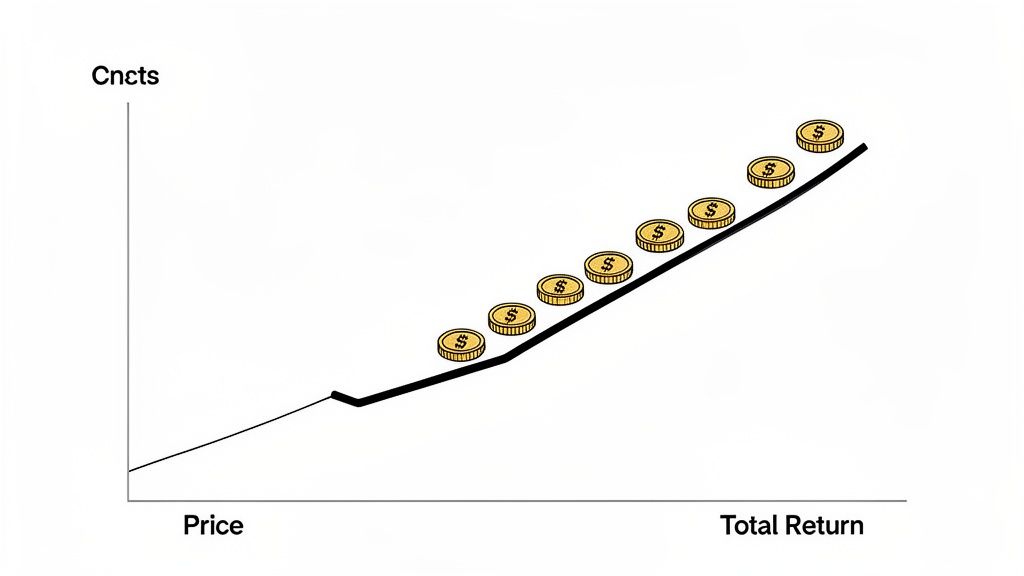
Mari kita tepis jargon. Pada dasarnya, "pulangan pelaburan" hanyalah wang yang anda peroleh atau hilang. Tetapi jujurnya, itu terlalu ringkas. Pemahaman sebenar lebih mendalam daripada sekadar memerhatikan tick stok.
Kesilapan pemula yang klasik adalah memberi tumpuan hanya pada apresiasi modal—adakah harga naik? Walaupun itu jelas penting, ia hanya separuh cerita. Metrik yang benar-benar penting ialah Pulangan Keseluruhan, kerana ia memberikan anda gambaran lengkap tentang prestasi wang anda.
Ia Lebih Daripada Sekadar Perubahan Harga
Mari kita lalui contoh pantas dalam dunia sebenar. Katakan anda membeli 100 saham sebuah syarikat teknologi besar pada $150 setiap saham. Pelaburan awal keseluruhan anda ialah $15,000. Sebuah tahun berlalu, dan stok itu kini didagangkan pada $160. Saham anda bernilai $16,000.
Jika anda hanya melihat harga, anda akan kata anda mempunyai keuntungan $1,000. Tidak teruk, tetapi ia gambaran yang tidak lengkap.
Ramai syarikat yang kukuh membayar dividen, berkongsi sebahagian keuntungan mereka dengan anda, pemegang saham. Bagaimana jika syarikat ini membayar $2 setiap saham dalam dividen sepanjang tahun itu? Dengan 100 saham anda, itu bermakna tambahan $200 tunai yang masuk ke akaun anda. Pendapatan itu adalah hasil langsung pelaburan anda, dan ia semestinya perlu dikira.
Keuntungan sebenar anda bukan sekadar peningkatan harga; ia adalah peningkatan harga ditambah sebarang pendapatan yang anda peroleh di sepanjang jalan. Mengabaikan dividen ibarat dibayar untuk pekerjaan tetapi lupa mengira bonus anda.
Mengapa Pulangan Keseluruhan Adalah Raja
Apabila anda mengambil kira pendapatan dividen itu, keuntungan sebenar anda ialah $1,200 (lonjakan harga $1,000 + $200 dalam dividen). Ini adalah Pulangan Keseluruhan anda, dan ia satu-satunya nombor yang memberikan anda pengiraan jujur tentang apa yang sebenarnya dihasilkan oleh pelaburan anda.
Mendapatkan perkara ini betul adalah penting atas beberapa sebab:
- Laporan Jujur: Ia memberitahu anda bagaimana pelaburan anda sebenarnya berprestasi, tanpa penipuan.
- Keputusan Lebih Bijak: Apabila anda membandingkan dua pelaburan berbeza, Pulangan Keseluruhan membolehkan perbandingan setara yang adil. Sebuah stok dengan pertumbuhan lebih perlahan tetapi dividen yang lumayan boleh dengan mudah mengatasi stok pertumbuhan mengagumkan yang tidak membayar apa-apa.
- Mencapai Matlamat Anda: Mengetahui pulangan sebenar anda adalah satu-satunya cara untuk mengetahui sama ada anda berada di landasan yang betul untuk mencapai matlamat kewangan anda, sama ada itu bersara awal atau menyimpan untuk membeli rumah.
Keuntungan Sekali Guna vs. Pengumpulan Jangka Panjang
Keuntungan $1,200 itu adalah gambaran pantas pulangan anda selama satu tahun. Tetapi keajaiban sebenar, rahsia untuk membina kekayaan serius, adalah apa yang anda lakukan dengannya seterusnya. Di sinilah pengumpulan berperanan.
Jika anda melabur semula $200 dividen itu dengan membeli lebih banyak saham, asas pelaburan anda menjadi lebih besar. Tahun berikutnya, anda akan memperoleh dividen daripada 100 saham asal anda ditambah saham baharu yang baru anda beli. Ini adalah pengumpulan dalam tindakan: wang anda mula membuat wang, dan kemudian wang yang dibuatnya mula membuat lebih wang.
Memahami konsep ini adalah segalanya. Pengiraan yang akan kita teroka—daripada pulangan ringkas kepada metrik yang lebih kompleks seperti CAGR—hanyalah alat untuk mengukur kesan pengumpulan yang kuat dari semasa ke semasa. Ia membolehkan anda melihat dengan tepat bagaimana keuntungan kecil yang konsisten boleh menjadi salji yang menggulung menjadi kekayaan yang ketara.
Mengira Pulangan Keseluruhan Portfolio Anda
Setelah kita membincangkan mengapa Total Return adalah piawaian emas untuk mengukur prestasi, mari kita mendalami pengiraan sebenar. Rumus-rumus ini bukan sekadar untuk pakar kewangan Wall Street; ia adalah alat penting bagi mana-mana pelaburan serius yang inginkan gambaran jelas tentang bagaimana wang mereka bekerja untuk mereka.
Titik permulaan yang paling biasa ialah Pulangan Mudah. Ia pantas, mudah, dan memberi anda gambaran ringkas tentang perubahan harga aset. Anggaplah ia sebagai angka utama.
Rumusnya tidak boleh lebih mudah lagi:
Pulangan Mudah = (Nilai Semasa – Nilai Awal) / Nilai Awal
Jadi, jika anda membeli sebuah saham pada $1,000 dan kini bernilai $1,150, pulangan mudah anda ialah ($1,150 - $1,000) / $1,000. Ia menghasilkan 0.15, atau keuntungan yang mantap sebanyak 15%. Tetapi ada kelemahan besar: pengiraan ini tidak mengambil kira sebarang hasil pendapatan yang dibayar oleh pelaburan, seperti dividen atau faedah.
Mendapatkan Gambaran Penuh dengan Total Return
Untuk mendapatkan ukuran prestasi pelaburan anda yang benar-benar tepat, anda perlu menggunakan rumus Total Return. Di sinilah anda mengambil kira segala-galanya — bukan sahaja perubahan harga, tetapi juga sebarang tunai yang pelaburan anda kembalikan ke poket anda.
Berikut adalah rumus yang menceritakan keseluruhan kisah:
Total Return = (Nilai Akhir + Pendapatan – Nilai Permulaan) / Nilai Permulaan
Ini adalah angka yang penting. Ia menggabungkan apresiasi modal dengan pendapatan yang anda perolehi, memberikan anda laporan prestasi pelaburan yang jujur. Jika anda mengurus pelbagai aset dan ingin mendalami kaedah yang terlibat, panduan ini tentang cara mengira pulangan portfolio dengan tepat adalah sumber yang sangat baik.
Mari kita lihat bagaimana ia dilaksanakan dengan contoh dunia sebenar.
Contoh Praktikal Total Return dalam Tindakan
Bayangkan anda melabur $5,000 dalam sebuah saham yang membayar dividen. Selepas setahun, nilai pasaran saham telah meningkat kepada $5,300. Selain itu, anda telah menerima $150 sebagai dividen sepanjang tahun tersebut.
Berikut adalah perbandingan kedua-dua kaedah:
Mengira Pulangan Mudah:
- Rumus: ($5,300 - $5,000) / $5,000 = 0.06
- Hasil: Pulangan sebanyak 6%. Tidak buruk, tetapi tidak lengkap.
Mengira Total Return:
- Rumus: ($5,300 + $150 - $5,000) / $5,000 = 0.09
- Hasil: Pulangan sebanyak 9%. Itulah angka sebenar.
Perbezaan sebanyak 3% ini bukanlah ralat pembundaran; ia merupakan sebahagian besar daripada pendapatan anda. Dengan mengabaikan dividen, anda sebenarnya merendahkan prestasi pelaburan anda.
Perbandingan Jelas antara Pulangan Mudah dan Total Return
Jadual ini benar-benar menonjolkan perbezaan antara melihat hanya perubahan harga berbanding gambaran kewangan yang lengkap.
| Ukuran | Pengiraan Pulangan Mudah | Pengiraan Total Return | Kesan |
|---|---|---|---|
| Komponen | Perubahan harga sahaja (Apresiasi Modal) | Perubahan harga + Pendapatan (Dividen, Faedah) | Total Return memberikan gambaran prestasi yang lengkap dan jujur. |
| Rumus | (Ending - Beginning) / Beginning |
(Ending + Income - Beginning) / Beginning |
Penambahan "Pendapatan" adalah pengubah peraturan. |
| Contoh Kami | ($5,300 - $5,000) / $5,000 = 6% | ($5,300 + $150 - $5,000) / $5,000 = 9% | Pulangan ringkas meremehkan keuntungan sebenar sebanyak 3%. |
Seperti yang anda lihat, hanya bergantung pada pulangan ringkas boleh mengelirukan, terutamanya bagi pelaburan yang direka untuk menjana pendapatan.
Menggunakan Helaian Perkiraan untuk Memudahkan Urusan
Mengira kira-kira ini secara manual adalah baik untuk satu atau dua pelaburan, tetapi apabila anda mempunyai portfolio penuh, hamparan jadual akan menjadi sahabat terbaik anda. Google Sheets dan Microsoft Excel adalah sempurna untuk ini.
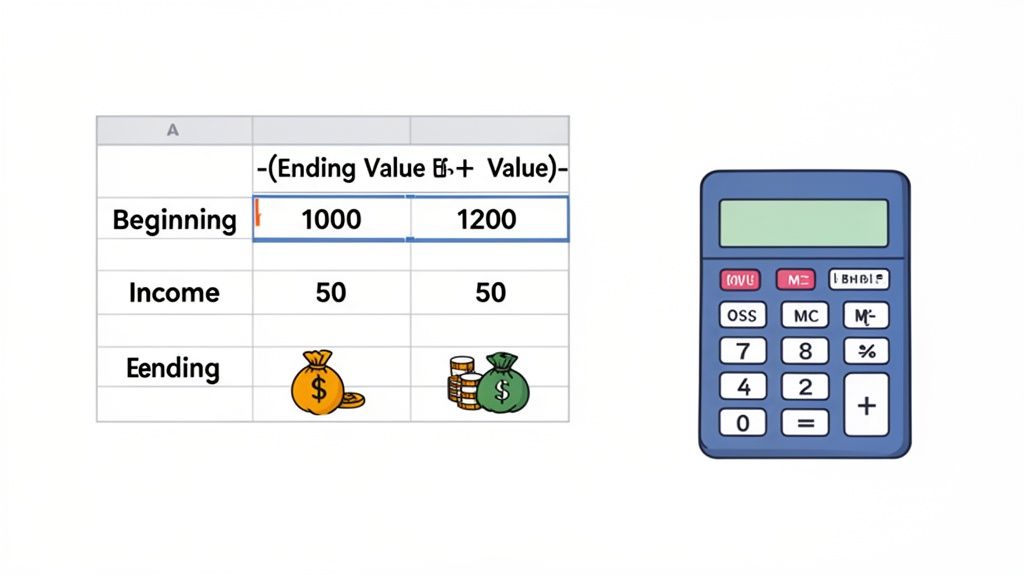
Anda boleh memasukkan formula Return Terus terus ke dalam sel:
=(Ending Value + Income - Beginning Value) / Beginning Value
Mari kita terjemahkan ini ke dalam hamparan jadual. Bayangkan anda mempunyai data anda dalam sel-sel ini:
- Sel A2: Nilai Permulaan ($5,000)
- Sel B2: Nilai Akhir ($5,300)
- Sel C2: Pendapatan ($150)
Hanya taip = (B2 + C2 - A2) / A2 ke dalam sel lain, katakan D2.
Tekan Enter, dan anda akan melihat 0.09. Dari situ, hanya perlu format sel untuk dipaparkan sebagai peratusan, dan anda akan mendapat 9.00%. Persediaan ringkas ini membolehkan anda menjejaki segala-galanya di satu tempat, memberi anda cara yang berkuasa dan konsisten untuk melihat bagaimana portfolio anda benar-benar melakukan.
Menggunakan CAGR untuk Mengukur Prestasi Jangka Panjang
Apabila anda melihat prestasi pelaburan anda dalam tempoh satu tahun, formula Pulangan Jumlah berfungsi dengan baik. Tetapi bagaimana pula apabila anda ingin melihat prestasi anda selama tiga, lima, atau bahkan sepuluh tahun?
Di sinilah purata mudah pulangan tahunan boleh menyebabkan masalah. Ia mengabaikan sepenuhnya kuasa pengkompaunan, yang merupakan pemacu pertumbuhan jangka panjang. Untuk mendapatkan gambaran sebenar prestasi anda dari semasa ke semasa, Kadar Pertumbuhan Tahunan Kompaun (CAGR) ialah metrik yang perlu anda ketahui.
CAGR melicinkan turun naik. Ia memberikan anda satu kadar pertumbuhan tahunan tunggal yang menunjukkan berapa pulangan pelaburan anda setiap tahun sekiranya ia telah berkembang pada kadar yang sangat stabil. Ia memotong hingar turun naik pasaran—semua naik dan turun itu—dan memberikan anda satu angka yang mencerminkan prestasi jangka panjang anda yang sebenar.
Fikirkan begini: CAGR menjawab soalan, "Pulangan tahunan yang stabil apa yang saya perlukan untuk mendapatkan daripada pelaburan permulaan saya kepada jumlah akhir saya?"
Mengapa Purata Mudah Tidak Memadai
Mari kita lihat mengapa purata mudah boleh mengelirukan. Bayangkan anda mempunyai pelaburan dengan pulangan tahunan berikut:
- Tahun 1: +20%
- Tahun 2: +10%
- Tahun 3: -15%
Purata mudah memberikan anda (20 + 10 - 15) / 3 = 5%. Tetapi nombor itu adalah khayalan—ia tidak mencerminkan apa yang sebenarnya berlaku kepada wang anda kerana ia mengabaikan bagaimana prestasi setiap tahun dibina di atas yang sebelumnya.
Pembezaan ini sangat penting untuk memahami bagaimana kekayaan sebenarnya dibina. Jika anda berminat dengan mekanik di sebalik ini, panduan kami tentang cara mengira faedah berkompaun memberikan penerangan yang sangat baik tentang prinsip-prinsip teras.
Anda sering mendengar tentang pulangan tahunan purata indeks utama, yang biasanya merupakan purata aritmetik mudah. Contohnya, sejak permulaannya pada tahun 1928, S&P 500 telah menghasilkan pulangan tahunan purata sekitar 8.55% (termasuk dividen). Penyelidik mendapat ini dengan menambah pulangan setiap tahun dan membahagi. Walaupun ia berguna untuk konteks sejarah, CAGR adalah yang anda perlukan untuk memodelkan perjalanan portfolio anda sendiri dengan tepat.
Memecahkan Rumus CAGR
Rumus untuk CAGR mungkin kelihatan agak menakutkan pada pandangan pertama, tetapi sebenarnya ia sangat mudah. Ia hanya memerlukan tiga maklumat: nilai permulaan, nilai akhir, dan bilangan tahun.
Berikut adalah rumusnya:
CAGR = [(Ending Value / Beginning Value)^(1 / Number of Years)] - 1
Mari kita ikuti contoh dunia sebenar untuk melihatnya dalam tindakan.
Katakan anda melabur $10,000 ke dalam dana bersama. Lima tahun kemudian, pelaburan itu telah berkembang kepada $16,105.
Berikut adalah input kami:
- Nilai Permulaan: $10,000
- Nilai Akhir: $16,105
- Bilangan Tahun: 5
Sekarang, mari kita masukkan nombor-nombor itu ke dalam formula langkah demi langkah:
- Pertama, bahagikan Nilai Akhir dengan Nilai Permulaan: $16,105 / $10,000 = 1.6105
- Seterusnya, kira eksponen: 1 / 5 tahun = 0.2
- Tingkatkan hasil daripada langkah 1 kepada kuasa eksponen itu: 1.6105 ^ 0.2 = 1.10
- Akhir sekali, tolak 1 daripada hasil itu: 1.10 - 1 = 0.10
Tukar perpuluhan itu kepada peratusan, dan anda akan mendapat CAGR sebanyak 10%. Ini bermakna $10,000 anda telah berkembang seolah-olah ia memperoleh pulangan tahunan yang stabil sebanyak 10% setiap tahun selama lima tahun, walaupun pulangan sebenar mungkin berubah-ubah.
Cara Mengira CAGR dalam Helaian Pembentangan
Mengira secara manual adalah cara yang baik untuk memahami konsep, tetapi untuk penggunaan seharian, helaian pembentangan adalah sahabat terbaik anda. Kedua-dua Google Sheets dan Excel menjadikannya sangat mudah.
Kaedah 1: Formula Langsung
Anda boleh terus menaip formula CAGR ke dalam sel. Katakan anda mempunyai data yang disediakan seperti ini:
- Sel A2: Nilai Permulaan ($10,000)
- Sel B2: Nilai Akhir ($16,105)
- Sel C2: Bilangan Tahun (5)
Formula itu adalah: =(B2/A2)^(1/C2)-1
Tekan enter, dan anda akan melihat 0.10. Hanya formatkan sel sebagai peratusan untuk memaparkan 10%.
Kaedah 2: Fungsi RATE
Pendekatan yang lebih kemas adalah menggunakan fungsi terbina dalam RATE, yang direka untuk jenis pengiraan seperti ini. Sintaksisnya ialah RATE(nper, pmt, pv, [fv]).
Berikut adalah maksud setiap bahagian untuk contoh kita:
- nper: Bilangan tempoh (C2, atau 5 tahun)
- pmt: Pembayaran setiap tempoh (gunakan 0, kerana anda tidak membuat deposit berkala)
- pv: Nilai semasa (jumlah permulaan anda, dimasukkan sebagai negatif: -A2)
- fv: Nilai masa depan (jumlah akhir anda: B2)
Formula penuh dalam helaian pembentangan anda akan kelihatan seperti ini: =RATE(C2, 0, -A2, B2)
Kedua-dua kaedah memberikan anda 10% CAGR yang sama. Ini adalah metrik yang wajib diketahui untuk membandingkan pelaburan yang berbeza dalam rangka masa yang sama, kerana ia memberikan anda ukuran prestasi yang standard dan adil. Jika anda ingin mendalami metrik penting ini, anda boleh mempelajari lebih lanjut tentang Compound Annual Growth Rate (CAGR).
Bagaimana IRR Mengambil Kira Keputusan Dunia Sebenar Anda
CAGR adalah metrik yang hebat, tetapi ia beroperasi dalam dunia yang sempurna—di mana anda membuat satu pelaburan dan kemudian tidak menyentuhnya selama bertahun-tahun. Itu bukan cara kebanyakan daripada kita melabur.
Kita menambah wang apabila kita dibayar, melabur semula dividen, dan mungkin mengeluarkan sedikit wang untuk perbelanjaan besar. Setiap langkah ini adalah aliran tunai, dan setiap langkah menolak pulangan akhir anda ke atas atau ke bawah. Untuk portfolio yang aktif dengan aktiviti, CAGR sekadar tidak dapat mengikuti. Anda memerlukan alat yang mencerminkan keputusan sebenar anda, dan itulah tepatnya yang dilakukan oleh Internal Rate of Return (IRR).
IRR adalah cara yang lebih canggih untuk melihat prestasi anda kerana ia mengambil kira masa dan jumlah setiap deposit serta pengeluaran. Ia mengira pulangan "berdasarkan wang", memberikan kadar tahunan yang anda peroleh berdasarkan aktiviti khusus anda. Ia adalah skor prestasi peribadi anda yang sebenar.
Apabila Masa Anda Menentukan Segalanya
Fikirkan ini: dua orang melabur dalam dana yang sama tepat, yang mempunyai pulangan tahunan yang sama tepat. Pelabur A bernasib baik dan menambah sejumlah besar wang tepat sebelum pasaran melonjak. Pelabur B menambah jumlah yang sama tepat sebelum kejatuhan.
Walaupun prestasi dana adalah sama untuk kedua-duanya, pulangan peribadi Pelabur A akan jauh lebih tinggi. Kenapa? Masa yang lebih baik. IRR adalah satu-satunya metrik yang benar-benar menangkap nuansa ini.
Inilah sebabnya memahami IRR sangat penting untuk menilai prestasi portfolio anda sendiri. Apabila anda mengukur prestasi anda berbanding indeks pasaran yang luas, anda biasanya membandingkan pulangan berdasarkan masa anda (yang mengabaikan aliran wang masuk) dengan pulangan indeks. Tetapi untuk mengetahui bagaimana keputusan anda memberikan pulangan, anda memerlukan pulangan berdasarkan wang—you memerlukan IRR. Ini terutama benar jika anda menambah atau mengeluarkan wang sepanjang tahun.
Jika anda tidak pasti metrik mana yang perlu digunakan, carta alir ini boleh membantu menunjukkan hala tuju yang betul.
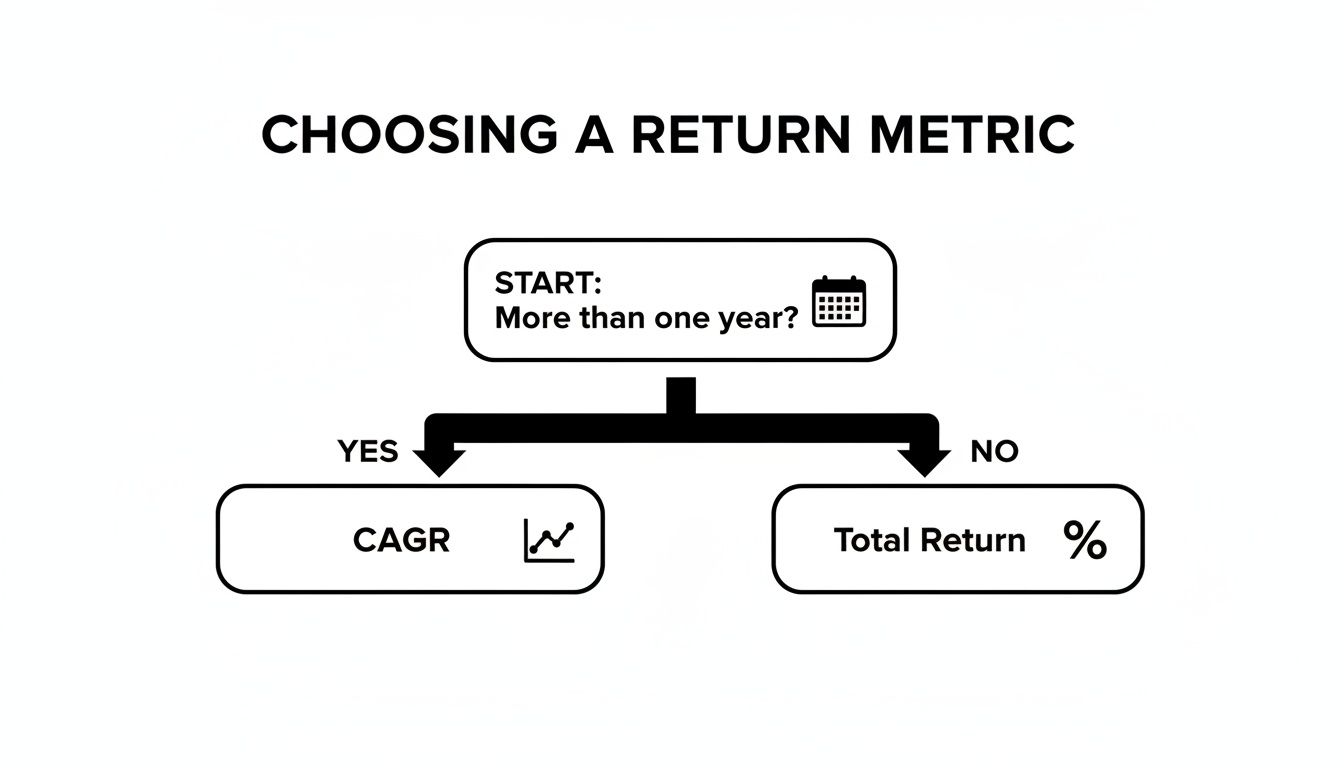
Seperti yang anda lihat, untuk pelaburan yang dipegang selama beberapa tahun tanpa wang masuk atau keluar, CAGR menjadi pilihan utama. Untuk pegangan jangka pendek, Total Return berfungsi dengan baik. Tetapi apabila anda mula menambah atau mengeluarkan dana, IRR menjadi ukuran paling tepat untuk kejayaan peribadi anda.
Mengira IRR dalam Helaian Elektronik: Senario Sebenar
Jujurnya, mengira IRR secara manual adalah mimpi ngeri. Ia melibatkan algebra percubaan dan ralat yang kompleks yang tiada siapa yang mempunyai masa. Syukurlah, kita mempunyai helaian elektronik.
Mari kita terokai senario yang biasa. Seorang pelabur memulakan tahun dengan $10,000 dalam akaunnya dan menambah wang secara berkala. Menjelang akhir tahun, akaun bernilai $13,500.
Berikut adalah perincian aktivitinya:
- 1 Januari: Pelaburan Awal (-$10,000)
- 1 April: Menambah Dana (-$1,000)
- 1 Julai: Menambah Dana (-$1,500)
- 31 Disember: Nilai Pasaran Akhir (+$13,500)
Satu perkara pantas tetapi penting untuk diperhatikan: semua sumbangan (wang yang masuk ke dalam) adalah negatif, manakala nilai akhir (wang yang boleh anda keluarkan dari) adalah positif. Helaian elektronik memerlukan data diformat sedemikian untuk berfungsi dengan betul.
Petua Pakar: Sentiasa senaraikan aliran wang anda secara kronologi. Mulakan dengan pelaburan awal, senaraikan semua sumbangan dan pengeluaran secara berurutan, dan selesaikan dengan nilai pasaran akhir pada tarikh penutup.
Menggunakan Fungsi XIRR untuk Ketepatan
Kerana sumbangan pelabur kita tidak berlaku mengikut jadual bulanan atau tahunan yang kemas, alat terbaik untuk tugas ini dalam Google Sheets atau Excel ialah fungsi XIRR. Ia dibina khusus untuk aliran wang yang berlaku pada selang masa yang tidak tetap.
Penyediaannya adalah mudah.
- Letakkan tarikh setiap transaksi dalam satu lajur (contohnya, Lajur A).
- Letakkan amaun aliran wang yang sepadan dalam lajur seterusnya (Lajur B). Ingat untuk menggunakan tanda negatif untuk semua wang yang anda masukkan ke dalam.
Beginilah rupanya dalam jadual:
| Tarikh (Lajur A) | Aliran Wang (Lajur B) |
|---|---|
| 2023-01-01 | -10000 |
| 2023-04-01 | -1000 |
| 2023-07-01 | -1500 |
| 2023-12-31 | 13500 |
Dengan anggapan tarikh anda berada dalam sel A2:A5 dan aliran tunai berada dalam B2:B5, formula ini hanyalah:
=XIRR(B2:B5, A2:A5)
Tekan enter, dan anda akan mendapat 14.89%. Ini adalah kadar pulangan dalaman tahunan yang diperibadikan untuk pelabur. Ia adalah ukuran sebenar prestasinya, dengan mengambil kira bukan sahaja apa yang dilaburkannya, tetapi bila. Itulah kuasa sebenar IRR.
Melihat ke Hadapan: Alat Pantas untuk Menggambarkan Pertumbuhan
Formula seperti CAGR dan IRR sangat bagus untuk menganalisis prestasi masa lalu anda. Tetapi jujurlah—kadang-kadang, apa yang anda benar-benar perlukan adalah gambaran jelas tentang masa depan anda untuk kekal bermotivasi. Helaian kerja adalah kuda kerja untuk analisis terperinci, tetapi untuk senario "bagaimana jika" yang pantas, pengiraan dalam pelayar yang baik adalah kawan baik anda. Mereka segera menukar sekumpulan nombor menjadi cerita visual yang kuat tentang pertumbuhan kompaun.
Anggapkan alat ini sebagai kotak pasir kewangan anda. Anda boleh bermain dengan pelbagai senario—apa jika saya menambah $50 setiap bulan? Apa yang berlaku jika saya melabur selama lima tahun lagi?—tanpa perlu membina satu pun formula helaian kerja. Ia kurang tentang menganalisis sejarah dan sepenuhnya tentang merancang laluan ke arah anda mahu pergi.
Bimbingan: Pengira Bunga Kompaun ShiftShift
Mari kita gunakan alat yang mudah tetapi berkesan, Pengira Bunga Kompaun ShiftShift, untuk melihat ini dalam tindakan. Matlamat di sini bukan sekadar untuk mendapatkan nombor akhir. Kita mahu melihat bagaimana wang anda masukkan dibandingkan dengan wang yang wang anda hasilkan dari semasa ke semasa. Pengasingan visual itulah di mana keajaiban berlaku.
Untuk bermula, anda hanya memerlukan beberapa maklumat:
- Pelaburan Awal: Jumlah sekaligus yang anda mulakan.
- Sumbangan Bulanan: Jumlah yang anda akan tambah secara konsisten.
- Kadar Faedah: Anggaran terbaik anda untuk pulangan tahunan.
- Tempoh Masa: Berapa banyak tahun anda merancang untuk membiarkannya berkembang.
Anda masukkan nombor-nombor itu, dan pengiraan itu sejana menghasilkan carta yang menunjukkan laluan pertumbuhan potensi anda.
Berikut adalah pengiraan yang memodelkan pelaburan dengan pengisian bulanan tetap.
Bahagian paling menarik adalah tepat pada warna. Kawasan biru mewakili Jumlah Sumbangan anda—wang yang diperoleh dengan susah payah yang anda masukkan. Kawasan hijau menunjukkan Jumlah Faedah. Anda boleh melihat dengan jelas titik perubahan di mana pendapatan anda mula melakukan lebih banyak kerja berat berbanding deposit anda. Itulah kompaun yang dibuat kelihatan.
Cara Membaca Keputusan
Wawasan sebenar dari carta ini bukan nombor akhir di kanan atas; ia adalah memahami cerita bagaimana anda sampai ke situ.
Pada permulaan, nilai portfolio anda hampir kesemuanya biru—ia kebanyakannya wang yang telah anda sumbangkan. Tetapi teruskan. Apabila tahun demi tahun berlalu, anda akan melihat bahagian "faedah" hijau mula membengkak, menjadi semakin besar sehingga akhirnya menjulang tinggi di atas warna biru.
Bagi ramai pelabur, saat "aha!" adalah melihat pendapatan pelaburan mereka akhirnya mengatasi simpanan peribadi mereka. Ia adalah apabila kompaun berhenti menjadi istilah buku teks dan menjadi daya yang nyata dan memotivasikan untuk matlamat kewangan anda.
Penggambaran sejenis ini menjadikannya sangat mudah untuk melihat kesan perubahan kecil. Apa jika anda menaikkan sumbangan bulanan anda sebanyak $100? Apa jika anda boleh memerah purata pulangan sebanyak 8% berbanding 7%? Hanya selak nombor dan tonton carta menggambar semula dirinya sendiri. Tiba-tiba, anda bukan sekadar merancang dengan nombor; anda sedang membina rancangan berdasarkan gambaran visual yang jelas tentang apa yang mungkin.
Kos Tersembunyi yang Mengurangkan Keuntungan Sebenar Anda
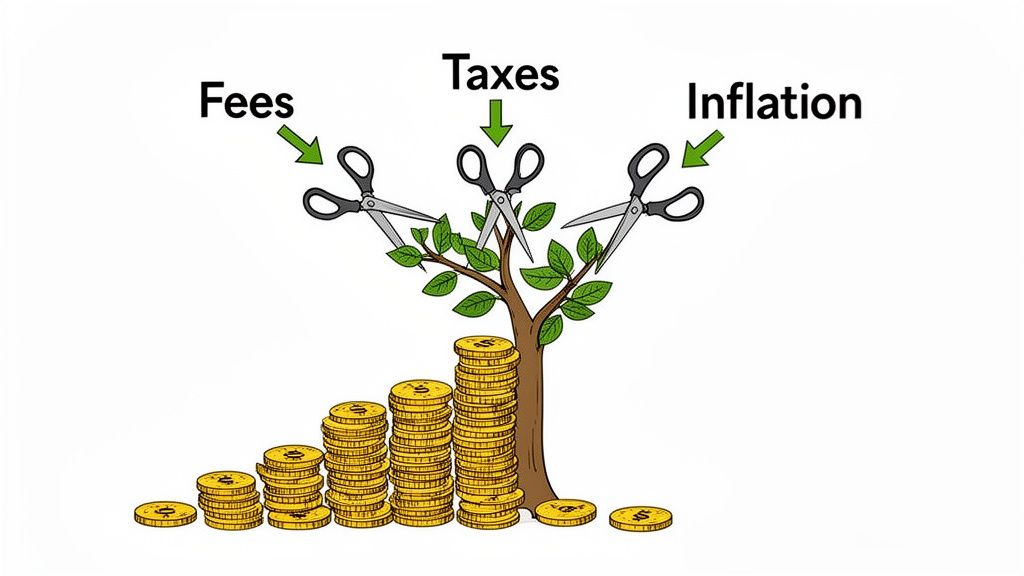
Mendapat nombor pertama itu—jumlah pulangan anda atau CAGR—terasa hebat. Tetapi ini adalah realiti yang sukar: ia bukan wang yang sebenar masuk ke dalam poket anda. Untuk mendapat gambaran jujur tentang prestasi anda, anda perlu mengambil kira kos sebenar yang sentiasa berlawanan dengan portfolio anda.
Anggap pulangan kasar anda sebagai garis permulaan. Dari situ, tiga pemain utama—yuran, cukai, dan inflasi—mula mengambil bahagian mereka. Satu-satunya cara untuk mengetahui jika wang anda benar-benar berkembang adalah dengan mengira pulangan anda selepas kos-kos ini melakukan kesannya.
Kesan Perlahan Yuran Pelaburan
Yuran pelaburan nampak kecil secara menipu. Ia sering disebut sebagai peratusan kecil, tetapi kesannya dalam jangka masa panjang boleh menjadi sangat besar. Satu perkara biasa yang anda akan lihat ialah nisbah perbelanjaan pengurusan (MER) untuk dana bersama dan ETF, yang dengan mudah boleh 1% atau lebih setiap tahun.
Sekarang, 1% mungkin kedengaran tidak berbahaya, tetapi itu adalah peratusan daripada keseluruhan portfolio anda, bukan hanya keuntungan anda untuk tahun itu.
Katakan portfolio anda meningkat sebanyak 7%. Yuran 1% bukan sahaja menurunkan keuntungan anda kepada 6%. Ia sebenarnya mengambil lebih daripada 14% keuntungan anda untuk tahun itu. Dalam beberapa dekad, yuran yang kelihatan kecil itu boleh secara senyap mengambil sepertiga atau lebih daripada apa yang anda boleh perolehi, semuanya kerana kehilangan penggandaan.
Jangan underestimate kuasa kemusnahan yuran. Sejumlah kecil peratusan yang dibayar tahun demi tahun boleh menjadi halangan terbesar antara anda dan matlamat kewangan anda. Sentiasa utamakan dana indeks berkos rendah atau ETF jika boleh.
Memahami Beban Cukai Anda
Cukai adalah satu lagi beban yang tidak dapat dielakkan terhadap pulangan sebenar anda, dan kerajaan sentiasa menunggu untuk mendapatkan bahagiannya. Berapa banyak yang anda berhutang bergantung sangat pada garis masa anda.
- Keuntungan Modal Jangka Pendek: Jual aset yang telah anda pegang selama setahun atau kurang, dan keuntungan anda akan dikenakan cukai pada kadar cukai pendapatan biasa anda. Itulah kadar tertinggi yang anda bayar.
- Keuntungan Modal Jangka Panjang: Pegang aset yang sama untuk lebih dari setahun, dan anda layak mendapat kadar cukai yang jauh lebih rendah. Ini adalah insentif besar untuk berfikir dan bertindak seperti pelabur jangka panjang.
Di sinilah perancangan cukai strategik memain peranan. Menggunakan akaun berkelebihan cukai seperti 401(k) atau IRA boleh mengecilkan beban ini dengan ketara dan meningkatkan pulangan bersih anda sepanjang hayat anda dengan serius.
Inflasi: Pembunuh Kekayaan Senyap
Akhir sekali, kita perlu bercakap tentang inflasi—peningkatan kos semua perkara secara berterusan, yang secara senyap mengikis kuasa beli wang anda. Jika pelaburan anda memperoleh 8% tetapi inflasi berlaku pada kadar 3%, pulangan sebenar anda hanyalah 5%. Ini adalah nombor yang benar-benar penting kerana ia memberitahu anda jika anda benar-benar mendahului.
Kesan sejarah di sini amat mengejutkan. Sepanjang abad yang lalu, S&P 500 telah mencatat pulangan nominal yang kukuh sekitar 10.46% setahun dengan dividen. Tetapi selepas anda menyesuaikan untuk inflasi, sesetengah kajian menunjukkan pulangan saham sebenar A.S. adalah lebih hampir kepada 4.73% setahun. Anda boleh mendalami lebih banyak data sejarah ini mengenai pulangan purata pasaran saham.
Untuk mengira pulangan sebenar anda sendiri, anda boleh menggunakan formula mudah ini:
Pulangan Sebenar = [(1 + Pulangan Nominal) / (1 + Kadar Inflasi)] - 1
Jadi, untuk pulangan 8% dengan inflasi 3%, pengiraannya kelihatan begini: [(1.08 / 1.03)] - 1. Itu memberikan anda 0.0485, atau pulangan sebenar 4.85%. Ini adalah satu-satunya angka yang memberitahu anda jika anda benar-benar semakin kaya.
Soalan Lazim Mengenai Pulangan Pelaburan
Mari kita tangani beberapa soalan yang hampir selalu timbul apabila pelabur mula serius menjejaki prestasi mereka. Memahami konsep-konsep ini adalah langkah besar ke arah memahami bagaimana wang anda bekerja untuk anda.
Apa yang Dianggap "Baik" sebagai Pulangan Pelaburan?
Ini soalan bernilai jutaan, bukan? Jawapan jujurnya adalah: ia bergantung sepenuhnya pada anda. Pulangan "baik" adalah relatif sepenuhnya kepada matlamat kewangan anda, seberapa banyak risiko yang anda sanggup ambil, dan apa yang pasaran lakukan pada masa itu.
Ramai orang sering menyebut purata sejarah S&P 500, yang berada sekitar 10% setiap tahun, sebagai ukuran universal. Tetapi itu hanyalah satu kayu pengukur. Bagi sesetengah orang, mengatasi ukuran tersebut adalah matlamat. Bagi yang lain, yang mungkin lebih hampir kepada persaraan, pulangan yang lebih rendah tetapi lebih stabil jauh lebih "baik" kerana ia melindungi modal mereka.
Pulangan yang baik hanyalah satu yang memastikan anda berada pada landasan yang betul untuk mencapai matlamat anda selepas anda mengambil kira penurunan sebenar daripada yuran dan inflasi.
Seberapa Kerap Saya Perlu Semak Pulangan Saya?
Jika anda melabur untuk jangka masa panjang, melihat prestasi portfolio anda setiap hari adalah resipi untuk kebimbangan. Ia sangat mudah untuk digetarkan oleh hingar pasaran jangka pendek dan membuat keputusan tergesa-gesa yang anda akan menyesal kemudian. Nasihat saya? Perbesarkan pandangan.
Ulasan suku tahun atau separuh tahun adalah ritma yang baik untuk diamalkan. Itu sudah cukup masa untuk melihat trend sebenar tanpa terperangkap dalam drama harian. Paling tidak, satu analisis mendalam setahun adalah wajib untuk memastikan strategi anda masih mantap dan pada landasan yang betul.
Apakah Perbezaan Sebenar Antara IRR dan CAGR?
Ini adalah titik kekeliruan yang biasa, tetapi ia sangat penting untuk difahami dengan betul kerana penggunaan ukuran yang salah boleh memberikan gambaran prestasi anda yang benar-benar berat sebelah. Semuanya bergantung pada cara anda melabur.
CAGR (Kadar Pertumbuhan Tahunan Kompaun) berfungsi dengan sempurna jika anda membuat satu pelaburan tunggal dan kali, dan tidak menambah atau mengeluarkan sebarang wang sejak itu. Ia pada dasarnya meratakan turun naik tahun ke tahun untuk memberikan anda kadar pertumbuhan tahunan purata yang bersih.
IRR (Kadar Pulangan Dalaman) dibina untuk dunia sebenar, di mana kebanyakan daripada kita secara rutin menambah wang ke akaun kami. Ia adalah pengiraan yang lebih canggih yang mengambil kira masa dan jumlah semua sumbangan dan pengeluaran anda. Jika anda seorang pelabur aktif, IRR adalah nombor yang benar-benar mencerminkan pulangan peribadi anda.
Bersedia untuk berhenti meneka dan mula membayangkan masa depan kewangan anda? Suite ShiftShift Extensions termasuk Kalkulator Faedah Kompaun yang kuat yang mengubah unjuran kompleks menjadi carta interaktif yang mudah. Lihat potensi pertumbuhan anda, model pelbagai senario, dan ambil kawalan perancangan pelaburan anda terus dari pelayar anda. Muat turun ShiftShift Extensions secara percuma dan mula merancang dengan lebih bijak hari ini.